


70/30 Aqueous Glycerin
−10 to 200 °F
- Vacuum
- No
- Oxidizers
- No
- Food grade
- Yes
The standard fill. Low temperature shift, but contains water.
Marquest ScientificFamily owned since 1978. Molded in Anaheim, assembled and tested in Costa Mesa, California.
Try a part number
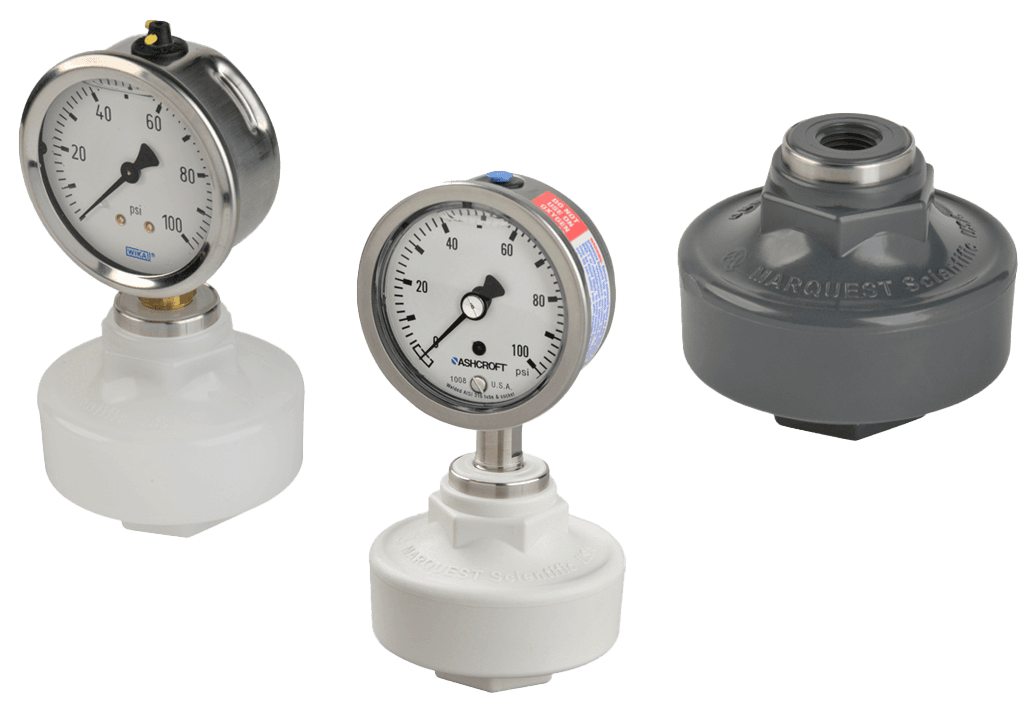
A diaphragm isolator is a small sealed hydraulic circuit. The process pushes on the diaphragm, the fill carries that pressure to the instrument, and the instrument never touches the media. The fill sets the limits of that circuit, so it deserves the same attention as the body material.
Applies to gauges, transmitters and switches on TUFF GUARD™ and Mini TUFF GUARD™ isolators.
Schematic shown with a gauge, not to scale
The body and diaphragm decide which media an isolator can handle. The fill matters when media or its gas gets past the diaphragm, and halogen gas permeates even a sound one. Work down the list and stop at the first line that describes your service.
Concentrated sulfuric acid limits the wetted materials too. PVC is generally not recommended at 93% and above, while PVDF and PTFE are rated for 98%. Confirm the body and diaphragm for your concentration and temperature first.
Liquids barely compress. Gas does, so a bubble acts like a spring between the diaphragm and the instrument and costs accuracy. Assemblies are filled under vacuum with degassed fluid for this reason.
Thin fluids respond quickly. Thick fluids respond slowly and damp pulsation. Viscosity climbs sharply in the cold, so a fluid that works at room temperature can turn sluggish outdoors.
A sealed fill grows with temperature, pushes on the diaphragm and reads as pressure. The volume is fixed, so it costs the most on low ranges. Silicone oil expands roughly 60% more per degree than glycerin.
Under vacuum, anything volatile in the fill boils or outgasses and forms the bubble you were trying to avoid. The water in an aqueous fill is why it is not used for vacuum service.
Undiluted glycerin freezes near 64 °F, close to room temperature. Water lowers that sharply: our 70/30 blend by volume freezes near -19 °F. That is why the standard fill is a blend.
Media can reach the fill through a failed diaphragm, or slowly by permeation through a sound one. The fill has to be safe in that event, so the chemistry often decides before anything else.
Each fluid is shown alone. An assembly can only work where the fluid and the body overlap.
Fill fluids
Isolator bodies
Temperature, °F
White mineral oil limits depend on the grade. Contact the factory.
−10 to 200 °F
The standard fill. Low temperature shift, but contains water.
−40 to 400 °F
Our vacuum fill. Larger temperature shift than glycerin.
−20 to 350 °F
Inert fluorinated fill for strong oxidizers and degassing halogens. The most expensive common fill.
Contact factory
For specifications that call for it. Not for EPDM diaphragms.
65 to 250 °F
Undiluted and thick. Freezes near room temperature.
Other fills are available by engineering review.
Sodium hypochlorite is a strong oxidizer that gives off chlorine, and chlorine slowly permeates plastics and fluoropolymers. A Modified PTFE diaphragm greatly reduces that permeation, but no diaphragm stops it entirely.
Chlorine permeates the diaphragm, or the diaphragm fails
The media meets the fill
Glycerin oxidizes, giving off heat and vapor
Gas in a sealed fill costs accuracy
Glycerin is an alcohol and can be oxidized. In our own bench tests, mixing glycerin directly with sodium hypochlorite produced an exothermic reaction with a small cloud of vapor.
We specify a fluorocarbon fill, Halocarbon 4.2 Oil, for sodium hypochlorite service, and we will not quote a glycerin fill when we know the application is hypochlorite.
Sits between the diaphragm and the instrument's sensing element, whether a Bourdon tube, diaphragm or piston, and carries the pressure. Gauge assemblies choose it on the part page. Transmitters and switches are filled by quote.
Used only on liquid-filled gauges. Surrounds the movement and damps the pointer. It never sees the process. Halocarbon assemblies normally keep a glycerin-filled gauge case. A Halocarbon case fill is available by quote, at added cost.
Send us the media, concentration, temperature and pressure range. We will never certify a fill for your service without knowing those.