Marquest ScientificFamily owned since 1978. Molded in Anaheim, assembled and tested in Costa Mesa, California.
Try a part number
California Flow Rate Regulation Exemption
Laboratory Faucets for Industrial and Non-Potable Water Applications
Key Takeaway
Marquest Scientific laboratory faucets designed for dispensing deionized, distilled, and ultrapure water are exempt from California's flow rate regulations under Title 20, Section 1605.3(h)(4). These are non-potable, industrial/laboratory filling fixtures—not residential or commercial plumbing fixtures subject to flow restrictions.
Understanding California's Flow Rate Regulations
California's Appliance Efficiency Regulations, codified in Title 20 of the California Code of Regulations (CCR), establish water efficiency standards for plumbing fixtures sold in the state. These regulations are enforced by the California Energy Commission (CEC) and apply to faucets, showerheads, toilets, urinals, and other plumbing products.
The regulations set maximum flow rates for various faucet types:
- Lavatory faucets: Maximum 1.2 GPM at 60 psi
- Kitchen faucets: Maximum 1.8 GPM (with optional 2.2 GPM temporary flow)
- Public lavatory faucets: Maximum 0.5 GPM at 60 psi
However, not all faucets are subject to these restrictions. The regulations include specific exemptions for industrial and laboratory applications where flow rate restrictions would impede the intended function of the equipment.
The Industrial/Laboratory Exemption
“Faucets used exclusively for filling operations in industrial processing or manufacturing are exempt from the flow rate standards.”
This exemption recognizes that certain faucets serve specialized industrial and laboratory functions where:
- The water dispensed is non-potable (not intended for human consumption)
- The primary function is filling operations (containers, vessels, equipment)
- The application is industrial processing or manufacturing
- Flow rate restrictions would impede the intended function
Why Marquest Laboratory Faucets Qualify for Exemption
Our laboratory faucets are specifically designed for dispensing deionized (DI) water, distilled water, reverse osmosis (RO) water, and ultrapure water—none of which are potable water sources. These are specialty fluids used in laboratory and industrial processes.
The primary use case is filling laboratory vessels, beakers, wash bottles, analytical instruments, and process equipment. These are filling operations within industrial processing and manufacturing environments.
Our fixtures are installed in analytical laboratories, cleanrooms, semiconductor fabrication facilities, pharmaceutical manufacturing, and chemical processing plants—all qualifying industrial environments.
The non-metallic thermoplastic construction (PVC, Polypropylene, PVDF) is specifically engineered for high-purity and corrosive media—clearly distinguishing these from standard residential or commercial plumbing fixtures.
Addressing Common Misconceptions
The California Energy Commission has not always clearly communicated the scope of these exemptions, leading to confusion in the marketplace. Some distributors, contractors, and end-users have incorrectly assumed that all faucets sold in California must meet residential flow rate standards.
Misconception:
“All faucets sold in California must meet the 1.2 GPM flow rate requirement.”
Reality:
The 1.2 GPM standard applies to lavatory faucets for residential and commercial hand-washing applications. Industrial filling faucets, laboratory faucets, and specialty fixtures are specifically exempted under Section 1605.3(h)(4).
Misconception:
“Laboratory faucets must be registered in the California MAEDbS database.”
Reality:
The Modernized Appliance Efficiency Database System (MAEDbS) certification requirement applies to regulated appliances. Exempt products—including industrial filling faucets—are not required to be certified in MAEDbS because they fall outside the scope of the flow rate standards.
Misconception:
“If a faucet isn't in the CEC database, it can't be sold in California.”
Reality:
Only regulated faucets must be certified. Exempt products can be legally sold and installed in California for their intended industrial/laboratory applications without MAEDbS certification.
Marquest Products Covered by This Exemption
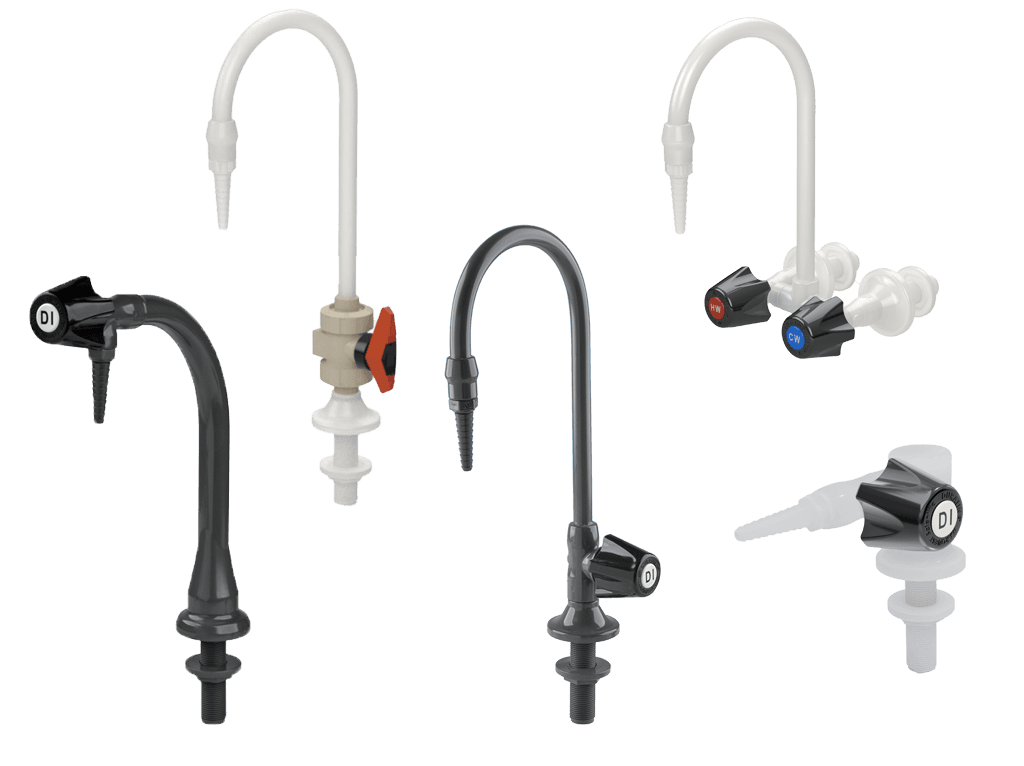
The following Marquest Scientific laboratory fixture product lines are designed for non-potable, industrial filling operations and qualify for exemption under CCR Title 20, Section 1605.3(h)(4):
- DURALINE™ DI Water Faucets
Heavy-duty laboratory faucets for commercial DI water applications
- Series LG Gooseneck Faucets
Classic gooseneck design for laboratory bench installations
- Series LT Laboratory Turrets
Multi-port turret fixtures for bench and wall mount applications
- Series LB Laboratory Base Fixtures
Compact deck and wall mount fixtures with Duraline valve technology